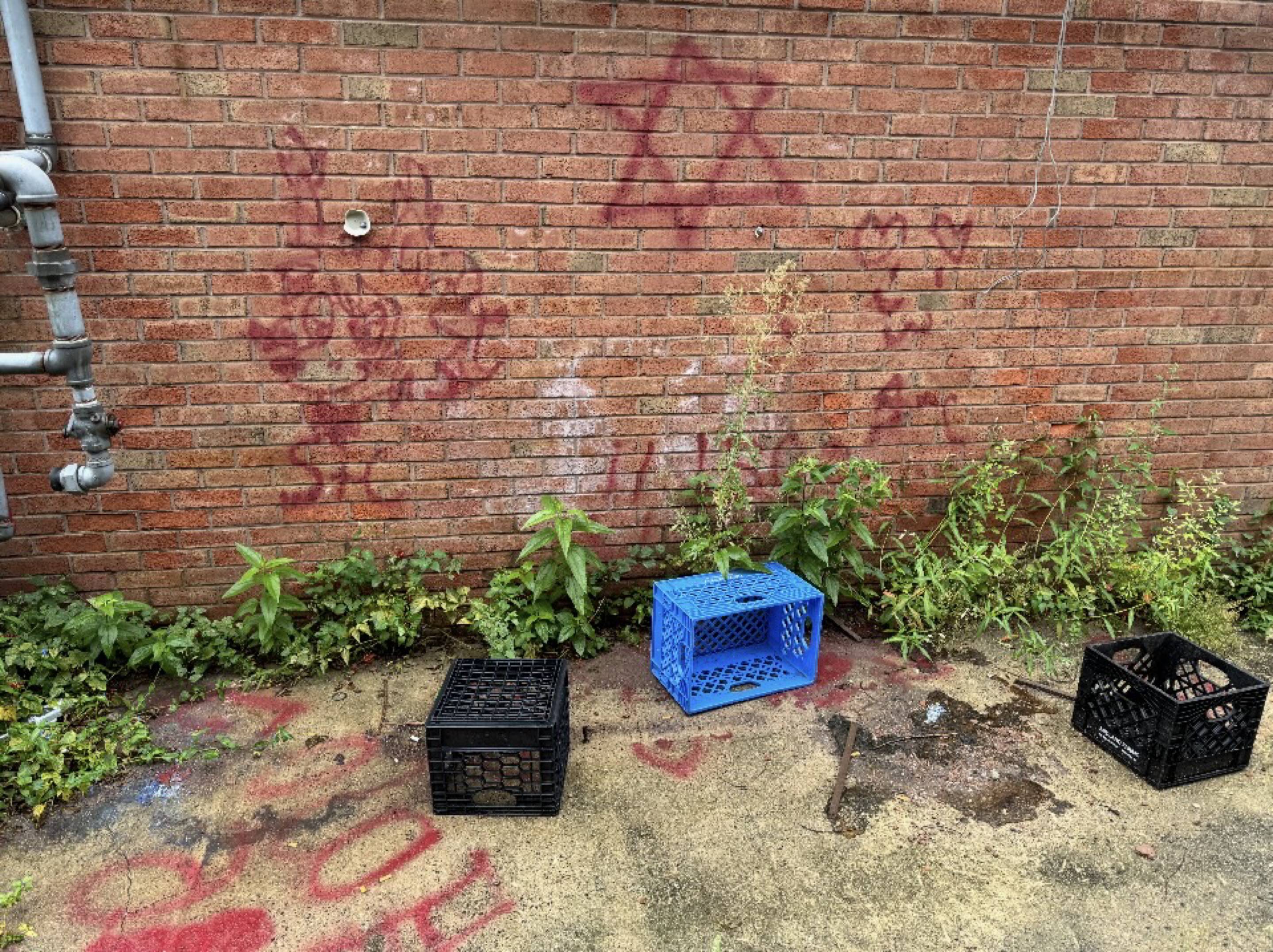
Graffiti painted on a brick wall and nearby pavement.
On March 17th, Allenhurst held its monthly town hall meeting — and I decided to attend. I'm not entirely sure what I expected to hear, but what I walked away with left me genuinely shaken. Perhaps it shouldn't have surprised me as much as it did. The signs, after all, had been there.
Many in the Jewish community have quietly carried stories like these for years — moments that felt a little off, interactions that left them feeling unwelcome, a sense of being disliked without explanation. Not always loud enough to name outright, but persistent enough to leave a mark. That night in Allenhurst, those quiet experiences were finally spoken aloud — and they were anything but subtle.
I have my own incident to share, which I'll get to later in this article. But first, the voices that stopped the room.
Talia Toussie
One of the most striking testimonies of the evening came from Talia Toussie, a resident who has called Allenhurst home for the past ten years.
When she first moved to town, neighbors assumed she was not Jewish — many misheard her last name as "Tuchi" — and during that time she experienced no problems. Once her Jewish identity became known, however, her treatment changed dramatically.
Toussie stated she had never experienced antisemitism before moving to Allenhurst. Since then, she has been subjected to repeated incidents of overt discrimination and stereotyping. A neighbor asked her where her horns were. Others questioned whether forty people would be living in her home — in reality, it was just her, her husband, and their two children. Local residents have refused to do business with her, telling her directly that they "don't do business with Jews" and assuming she wouldn't pay, despite knowing nothing about her. She also described a zoning dispute in which someone directed the phrase "you people and your fences" at her — even though, as she noted, she has the same type of fence as anyone else in the neighborhood.
Toussie acknowledged that some residents in Allenhurst are decent, but said that on the whole, her experience living there has been marked by persistent antisemitic attitudes and treatment.
Dr. Mitch Sabagh
The tension in the room only grew when Dr. Mitch Sabagh approached the microphone. A professional and family man by his own description, Dr. Sabagh came with a pointed question and a personal grievance that clearly had been weighing on him.
He told the room that the very first thing he asked Eli — upon hearing that Eli was planning to open a new establishment, the Reef Club, in place of the now-closed Mr. C's — was whether he would actually be served a drink there. The question wasn't hypothetical. Dr. Sabagh stated plainly that he had not been served at Mr. C's. Turning to face the crowd and gesturing deliberately, he described the experience: a bartender who would not make eye contact with him, a humiliation he had endured in front of his guests.
The room didn't stay quiet. A woman in the crowd responded dismissively — something to the effect of "oh, please" — and Dr. Sabagh wheeled around, pointed directly at her, and fired back: "You weren't there. Keep your mouth shut." He turned back to the microphone and pressed on — he had wanted a drink, he was ignored, and it stayed with him. Why, he asked, would that happen to him?
From somewhere else in the crowd came a sharp retort: "Maybe you're an asshole."
The gavel came down. A council member reminded attendees that comments were only permitted from the microphone.
Dr. Sabagh closed his remarks with composure, telling the room that Allenhurst is one town, and that while it is a democracy, it is a democracy that belongs to its residents — and then he took his seat.
A Pattern Older Than It Looks
The tension in Allenhurst didn't begin at that March town hall. It had been building for at least a year. In May 2024, Frieda O. Adjmi, a Syrian Jewish community member and longtime Planning Board member, was sworn in after winning Allenhurst's 2024 election. Rather than being met with celebration, her victory was immediately clouded by controversy. State and federal law enforcement opened an investigation into allegations of election fraud, citing concerns over a voter registration surge in which the number of eligible voters had increased by nearly 75% in roughly one year. Critics alleged that members of the Syrian Jewish community had registered to vote at summer homes to influence the election. Reports of vehicles with New York license plates at the polls fueled suspicions, and election officials placed a large number of voters on a challenge list, requiring them to produce proof of residency.
Following a thorough investigation, the Monmouth County Prosecutor's Office ultimately concluded the probe across all three towns — Allenhurst, Deal, and Loch Arbour — finding no evidence of criminal activity and filing no criminal charges. The investigation was closed. The press coverage, however, had already done its damage — leaning heavily into suspicion and background rather than qualifications or governance. To many in the Jewish community, the message was hard to miss: a Jewish woman winning office in Allenhurst was, for some, simply unacceptable.
The Graffiti That Wasn't Investigated
The graffiti incident that perhaps best encapsulates the problem in Allenhurst occurred in June 2024, just weeks after Adjmi's swearing-in. The target was the New Allenhurst Gourmet, a local grocery store in the process of transitioning to a kosher establishment — a change that had not gone unnoticed by some longer-term residents. Someone had painted many Jewish stars across the wall and staircase and on the floor near the roadway, for all to see. Beside them, written on the ground: "go home." The stars were reminiscent of the marking of Jewish businesses in Nazi Germany — a deliberate, centuries-old tactic of targeting and humiliation.
The message could not have been clearer. And yet what happened next was perhaps even more troubling than the graffiti itself.
When the incident was reported, the police chief was asked to check the surveillance cameras on Main Street and Allen Avenue — cameras that could have identified the perpetrator. Instead of doing so, he instructed public works to clean the graffiti off the private property. The evidence was erased before it could be properly investigated. Adjmi, upon learning of this, directed the chief to contact the bias crime unit — the appropriate response to what was, by any definition, a hate crime. She never received confirmation that he made that call, and no proof was ever provided that he did.
No press covered it. Not a single outlet picked up the story of antisemitic graffiti targeting a Jewish-owned business in a town that had just elevated a Jewish woman to its highest local office. For a place this small, that kind of silence doesn't happen by accident — it happens when people decide, consciously or not, that some stories don't need to be told.
Judith Horowitz
Judith Horowitz took to the microphone with a message that was equal parts frustration and heartbreak. Her appeal was simple: why can't everyone just get along? She described herself as someone who is friendly with everybody, regardless of race, ethnicity, or creed — and she meant it. But her goodwill, she made clear, had not always been returned.
She acknowledged that the beach club has its positives, but didn't shy away from the darker side of her experience there. She recalled that shortly after moving to Allenhurst, the beach club threw a large party — the kind where drinks flowed freely and the night got loud. At some point during that same evening, a beach club resident walked past the Horowitz home, where the family was hosting a gathering of their own. What that person said to them has apparently never left her. Turning to face the audience, she recounted it with visible emotion: they were told that they were Jews, and that their house was going to be burned down.
The room reacted immediately. Someone called out "horrible" — and it was.
Horowitz was quick to make clear that she and her family came to Allenhurst without hostility toward anyone. They wanted to be neighbors, nothing more. She acknowledged that the summer months bring crowds up and down the Jersey Shore — Asbury Park, Belmar, the whole coastline feels it — but argued that the particular tension in Allenhurst has no reasonable explanation. Her closing message was directed at the entire room: go to the beach, enjoy your family, and leave the hatred behind.
Frieda O. Adjmi — Closing the Night
After hours of testimonies, interruptions, and a crowd that had grown increasingly restless and at times openly hostile to the speakers sharing their experiences, Frieda O. Adjmi stepped up to the microphone. What followed was perhaps the most powerful moment of the entire evening.
She began with a simple but firm rebuke of the heckling that had punctuated the night. She made clear that dismissing or devaluing someone's pain is not a matter of opinion — it is a form of discrimination. If someone says they were hurt, if someone says they experienced antisemitism, the response cannot be mockery or disbelief. That, she told the room, is unacceptable.
And then she told her own story.
Adjmi has lived with antisemitism in Allenhurst since the 1990s. When she first moved here and went to the beach club, she would find her locker stuffed to the brim with garbage. On the mirror inside, someone had written "Syrian Free in '93." She was a young woman of twenty years old. She cried. The advice she received was not to confront it or report it — but to stay in her lane, because the locals didn't like change, and they didn't like different people.
She didn't run. Instead, she became an active member of the community. She went door to door raising money for the police department and the fire department — with her young children by her side. At more than one door, she could hear a spouse being called over to come look: there's a Syrian Jew at the door. Come see them. It was, she said quietly, a sad experience.
She channeled that pain into action. In the early 2000s, she spearheaded a playground project with a simple but powerful vision: a place where children from all backgrounds could grow up side by side, play together, and perhaps render the name-calling and the picking irrelevant by simply knowing one another. It was a quiet act of community-building, and it mattered to her deeply. In recent years she has continued investing in that same park, expanding and improving it — the mission unchanged after two decades.
More recently, she took on another project: pickleball courts. It seemed straightforward enough — a recreational amenity for the community. But it was met with the same resistance she had come to expect. Certain voices in town pushed back, arguing that they didn't want to encourage people from neighboring towns to come and play. Adjmi's answer was consistent and clear: Allenhurst is not a gated community. Its open spaces and parks are open to all.
The courts got built. And then, on the first day of Passover, they were vandalized.
Many residents felt the timing was not a coincidence. The pickleball courts had been Adjmi's project from concept to completion — a fact that was not lost on anyone paying attention. Given the rising temperature of hostility on social media and in local town meetings, a heaviness that could be felt weighing over the town, it was hard to dismiss the incident as random. Tensions, she has observed, inspire deviant behavior.
There is a troubling pattern that runs through much of what has unfolded in Allenhurst over the years — one where the same circles of opposition seem to reappear across different issues. A family that fought the Eruv project along the Jersey Shore. A building restriction selectively applied to a kosher business owner but quietly dropped for his non-Jewish successor. Old rules suddenly resurfacing when a Jewish-owned establishment comes before a planning board, only to be forgotten again when it doesn't. A non-resident politician who shows up to champion a controversial beach club program that serves 140 non-resident children daily — without any structure to shelter those children in lightning storms or dangerous heat. It was for precisely that reason that Adjmi made the decision this year not to continue the camp program until an appropriate facility is in place. The pushback was swift.
When you stand back and look at the full picture — the graffiti, the lockers, the slurs at the door, the vandalized cabana, the swastikas chalked on a driveway, the egged cars, the pickleball courts defaced on Passover, the testimony after testimony at that town hall — what emerges is not a series of isolated incidents. It is a decades-long effort to make certain people feel that they do not belong here.
But Adjmi didn't close the night with grievances. She closed it with purpose.
"I ran because I wanted to heal the pain, heal the hate," she told the room. "That's why I'm here."
She closed with the words she said she always tries to leave people with — that she loves them, and that her hope is that one day, they'll be able to say it back.
The room, which had been so quick to heckle and dismiss throughout the night, had no retort for that.
Conclusion: Closer Than We Think
I mentioned at the beginning of this article that I had my own story to tell. Here it is.
A couple of summers ago, I was working a photoshoot on a hot day by the beach in Allenhurst. I ducked into Mr. C's hoping to buy a bottle of water. It was a simple errand — the kind you don't think twice about. But not one server, not one worker inside, so much as glanced in my direction. The indifference was total. I stood there for a moment, confused, and then I left. I didn't dwell on it. I told myself maybe they were busy, maybe it was just an off day. I moved on.
It wasn't until I sat in that town hall meeting and listened to Dr. Mitch Sabagh describe his own experience at that same establishment — the bartender who wouldn't make eye contact, the humiliation in front of his guests, the question that had stayed with him for years: why? — that the lightbulb went on. I finally had my answer. It hadn't been a bad day. It hadn't been an oversight. Dr. Sabagh's testimony handed me a context I hadn't known I needed, and it reframed an experience I had brushed off as nothing into something I could no longer ignore.
My sister's experience this past summer drove the point home even further. She rented a house in Allenhurst and fell into an easy routine, stopping into the local coffee shop almost every day. The staff came to know her face. Things were fine — until the day she brought her five-year-old son with her. He wears a kippah. Something shifted immediately. The warmth evaporated. The welcome was gone. She felt it plainly, the way you feel a change in temperature — not imagined, not manufactured, just suddenly and unmistakably there. Her little boy had done nothing but walk through the door. That was enough.
This is what antisemitism looks like when it doesn't make the news. It doesn't always arrive with slurs screamed on a street corner or swastikas spray-painted in broad daylight — though as we've seen, it does that too. More often, it looks like a bartender who won't make eye contact. A locker filled with garbage. A cold shoulder the moment a five-year-old's kippah comes into view. A graffiti scene scrubbed clean before investigators can arrive. A crowd that heckles a woman for describing her own pain. Pickleball courts defaced on the first day of Passover. Jewish stars painted across a building in a style that echoes some of the darkest chapters in Jewish history.
The people who spoke at that March town hall in Allenhurst were not complainers or agitators. They were a professional, a family man, a longtime resident, a young mother, and a public figure who has spent decades absorbing hatred quietly while pouring herself into a community that has not always wanted her there. They came to a microphone in a small room in a small town on the Jersey Shore and told the truth. Some in that room didn't want to hear it. But the rest of us should.
Antisemitism in Allenhurst is not a rumor. It is not a political talking point or an overreaction. It is a lived, documented, decades-long reality — one that has been minimized, dismissed, cleaned up, and kept out of the press for far too long. The question at the top of this article was whether antisemitism is going unchecked in Allenhurst. After that night, the answer is hard to argue with.
It is. And it has been for a very long time.
Francine Styler is a contributor to The Allenhurst News.